
How India’s Bank Holidays Are Decided (RBI & NI Act)
India’s bank holidays are set by government notifications under the Negotiable Instruments Act, 1881, not by the Reserve Bank of India alone. The central government and each state government declare holidays, the RBI publishes the lists, and a separate national rule closes banks on the 2nd and 4th Saturday of every month. That is why a bank holiday in Mumbai is not always a bank holiday in Lucknow. Check the live answer for your state on our India bank holiday pages.
This guide explains where the holidays come from, how the Saturday rule works, why dates differ by state and city, and which payment systems keep running.
The legal basis: Section 25 of the Negotiable Instruments Act
Section 25 of the Negotiable Instruments Act, 1881 allows the central government and state governments to declare days as public holidays for the purposes of the Act. A day notified under the Act counts as a public holiday for the purposes of negotiable instruments such as cheques and bills, which affects when they fall due. It is a close cousin of the UK’s 1871 logic.
Because states can issue their own lists, India has national holidays such as Republic Day, Independence Day and Gandhi Jayanti, and state or regional holidays tied to local festivals and state formation days.
The role of the Reserve Bank of India
The RBI does not invent holidays, but it is the place where banks and the public find them. It publishes the holiday list for each state, showing which days are holidays under the Negotiable Instruments Act, plus the days its own offices are closed. Banks follow these lists and the notifications behind them.
The RBI’s holiday information is organised by regional office, because holidays can differ between centres in the same state. A festival can close banks in one city and not in another, and the lists for Mumbai, Belapur and Nagpur are separate. Our India state pages resolve each state to the correct RBI office for this reason.
The 2nd and 4th Saturday rule
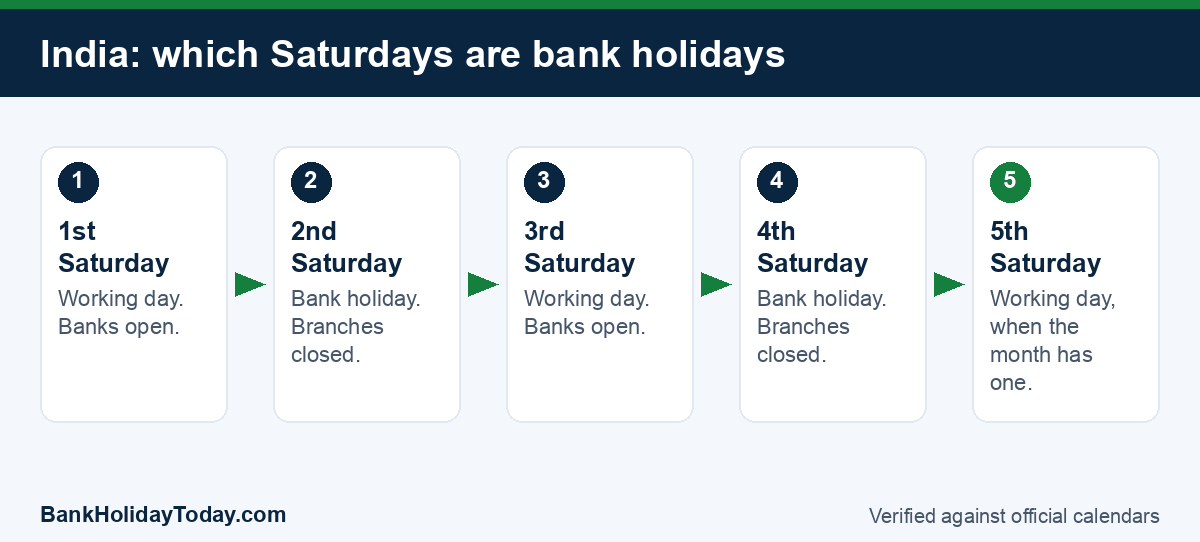
The weekly pattern is the part most people remember. By a notification dated August 20, 2015, published in the Gazette of India, the central government declared the 2nd and 4th Saturdays of every month as holidays under Section 25. The RBI announced on August 28, 2015 that the rule applied to all banks, whether or not they are listed in the Second Schedule of the RBI Act, from September 1, 2015. All Sundays are closed as well.
The 1st, 3rd and 5th Saturdays are working days, which the RBI described as “working Saturdays”. In its announcement the RBI also noted that future-dated RTGS and ECS transactions with a value date on a 2nd or 4th Saturday would not be processed.
Festival dates can shift by a day
Many Indian festival holidays follow the lunar calendar, and some depend on the sighting of the moon. For those, the date on a published list can move by one day, and the final date is confirmed shortly before the festival. Our site marks such holidays as provisional instead of stating them as certain. If a holiday matters to you, check the RBI list for your state a few days ahead.
A worked example: December 2026
The 2026 calendar shows how the layers combine. Christmas, December 25, is a national holiday on the RBI list, and falls on a Friday. Saturday, December 26 is the 4th Saturday of the month, so banks are closed under the weekly rule, and Sunday, December 27 is closed as always. In most states that is a three-day closure, from Friday to Sunday, reopening on Monday, December 28. Earlier in the month, Saturday, December 12 is the 2nd Saturday and is also closed.
A few north-eastern states add their own days around Christmas, which is exactly where the state-by-state lists matter. A single national calendar would get those wrong.
How to check your own state
Use the state pages on this site, which resolve each state or union territory to the correct RBI regional office and show the full-year list, the next closure and a countdown. For a one-off check, the RBI holiday matrix lets you pick a regional office and month. If you are travelling or paying someone in another state, check their state as well as yours.
What keeps working when banks are closed
India’s digital payments do not follow the holiday calendar. NEFT began running 24x7 in December 2019, and RTGS followed, with 24x7 operation from December 14, 2020; the RBI noted that India would be one of the few countries to run its RTGS system round the clock throughout the year. IMPS and UPI also run 24/7. ATMs and card payments keep working too, although RTGS has short intervals between end-of-day and start-of-day processing. Only branch services, such as cash counters and cheque processing, depend on the working-day calendar.
Does the five-day banking week change this?
Bank unions have asked for a five-day week for years, and viral messages periodically claim that every Saturday is already a bank holiday. As far as we can find, the 2nd and 4th Saturday notification remains the schedule in force, and we have seen no later notification changing it. Before you act on a forwarded message, check the RBI website or the Gazette. If the rule does change, this guide and our data will be updated.
Quick answers
Who decides bank holidays in India?
The central and state governments declare them under Section 25 of the Negotiable Instruments Act, 1881. The Reserve Bank of India publishes the lists by state and regional office.
Are banks open on the 1st, 3rd and 5th Saturday in India?
Yes. Banks are closed on the 2nd and 4th Saturdays and every Sunday. The 1st, 3rd and 5th Saturdays are working days.
Since when are banks closed on the 2nd and 4th Saturday?
Since September 1, 2015, after a central government notification dated August 20, 2015. The RBI confirmed it applies to all banks.
Why do bank holidays differ by state in India?
State governments can notify their own holidays under Section 25, and festivals and state days differ across India. Holidays can differ even between RBI centres in the same state.
Do UPI and NEFT work on bank holidays in India?
Yes. UPI and IMPS run 24/7. NEFT has run 24x7 since December 2019 and RTGS since December 14, 2020.
Is every Saturday a bank holiday in India now?
No. As far as we can find, only the 2nd and 4th Saturdays are holidays. Verify any message claiming otherwise on the RBI website.
Sources
- RBI press release, 28 Aug 2015 — holidays on 2nd and 4th Saturdays
- RBI press release — RTGS available 24x7
- RBI — holiday matrix by regional office
Dates and rules were checked against the sources above. Holiday calendars can change; confirm with your bank before a time-sensitive transaction.