
How US Bank Holidays Are Decided: Fed K.8 Calendar
US bank holidays are decided in two layers. Congress names 11 federal holidays in law, and the Federal Reserve publishes the days its Reserve Banks close on a schedule called K.8. Banks follow the Fed’s schedule, so that schedule is what actually decides when branches shut. Check the live answer for your state on our US bank holiday checker.
This guide walks through how the K.8 schedule works, the weekend rules, why banks follow it, and where individual banks and states can differ.
Layer one: the law
The list of federal holidays is set by Congress in 5 U.S.C. § 6103. Most holidays are tied to a fixed date, such as July 4 or December 25, and the rest to a weekday rule: the third Monday of January, the third Monday of February, the last Monday of May, the first Monday of September, the second Monday of October and the fourth Thursday of November. Juneteenth, June 19, was added in 2021.
That statute governs pay and leave for federal employees. It is the starting point, but it does not tell banks to close.
Layer two: the Federal Reserve K.8 schedule
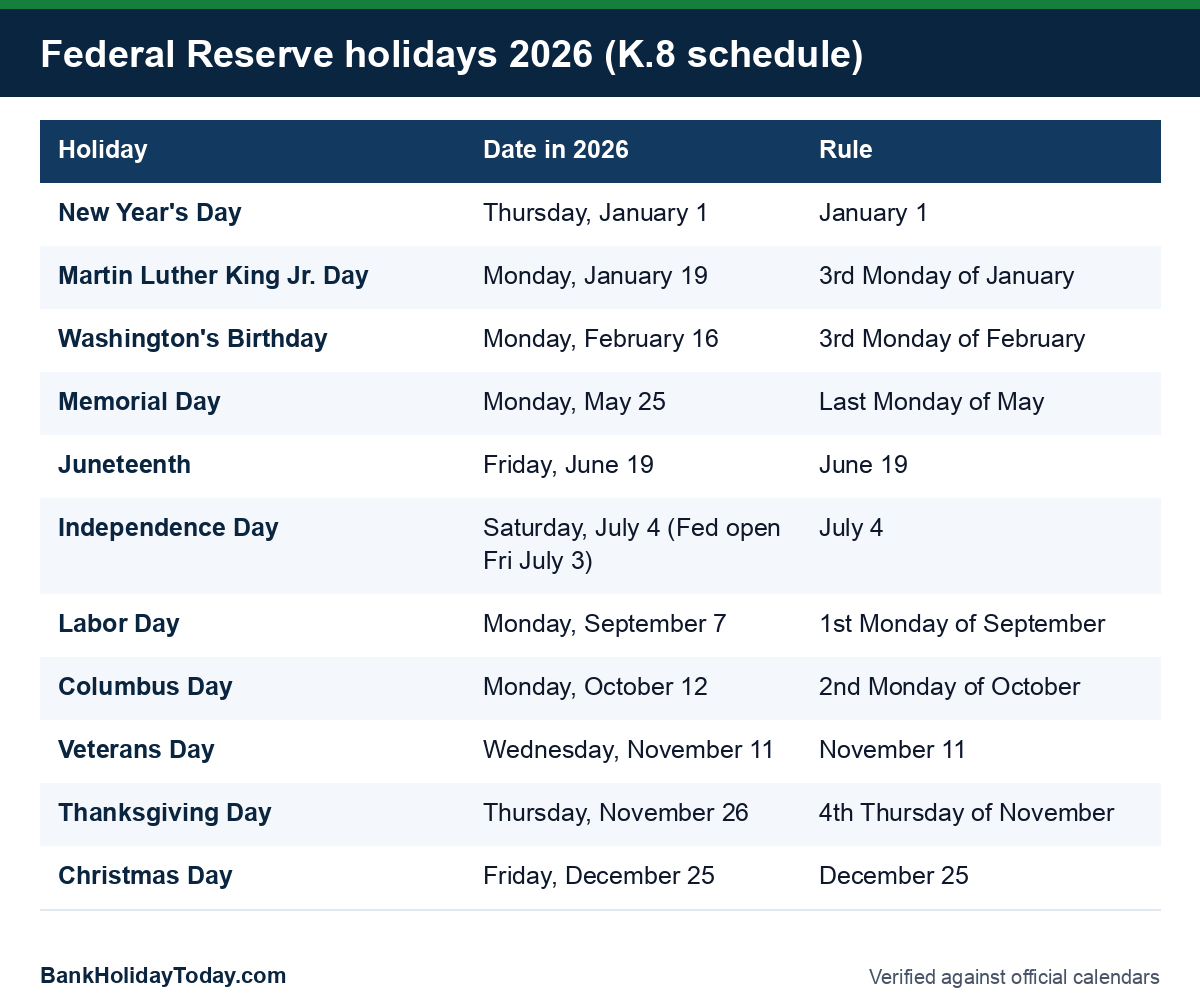
The Federal Reserve publishes the days its Reserve Banks and Branches observe in its holiday schedule, known as K.8, with dates listed several years ahead. The Reserve Banks observe the same 11 holidays as the federal calendar. The 2026 dates are shown below.
The weekend rules
Two rules cover holidays that fall on a weekend. If a holiday falls on a Saturday, the Reserve Banks and Branches are open the preceding Friday, although the Fed’s Board of Governors is closed that Friday. That applies to Independence Day in 2026, so Friday, July 3 is a normal banking day. If a holiday falls on a Sunday, all Federal Reserve offices are closed the following Monday.
The Saturday rule is the opposite of what federal employees get, and it is the most common reason lists on other websites disagree. If you see a site telling you banks are closed on a Friday for a Saturday holiday, check it against the Fed.
Why banks follow the Fed
Banks do not close on holidays because a law tells them to. They close because the plumbing stops. The Fed operates Fedwire, the system for large same-day transfers, and FedACH, which settles a large share of everyday electronic payments such as direct deposits and bill payments. These systems do not process on Reserve Bank holidays, so payments queue until the next business day.
The industry does not even agree on one definition of a banking day. Nacha, which writes the ACH rules, has noted that Nacha, The Clearing House and the Federal Reserve use varying definitions within their own rule sets, and it has consulted members about aligning them. Almost every bank, credit union and brokerage treats the Fed’s calendar as the working definition.
A worked example: the 2026 calendar
Follow the 2026 dates through the rules. January 1 is a Thursday, so banks are closed that day. July 4 falls on a Saturday, so the Reserve Banks stay open on Friday, July 3. Juneteenth, June 19, is a Friday, which gives banks a three-day weekend. Thanksgiving is the fourth Thursday of November, so November 26. Christmas Day falls on Friday, December 25. That is 11 holidays on the schedule, but only 10 weekday closures for the Reserve Banks in 2026, because Independence Day falls on a Saturday and they stay open on the Friday.
The next year works differently: in 2027, Christmas Day is a Saturday, so the Fed’s Reserve Banks stay open on Friday, December 24, 2027. People often assume the opposite and plan around a closure that never happens.
Where banks and states can differ
Each bank sets its own branch hours, so a few may open on a federal holiday, especially a smaller one such as Columbus Day. Branches inside shops and some credit unions may keep different hours too. States can also declare their own holidays. Texas, for example, closes state offices the day after Thanksgiving, but banks stay open because the Fed is open.
The Fed’s weekday rule also means nothing special happens on days like Election Day or Good Friday: they are not on the schedule, so banks are open.
The exception: instant payments
The Fed’s FedNow Service, launched on July 20, 2023, runs every day of the year, including holidays, and settles in near real time. It is available to US depository institutions that join, so whether you can use it depends on your bank. The older ACH and Fedwire rails still pause on holidays.
How this site checks US bank holidays
Our US data comes from the Fed K.8 schedule, with observed-date rules applied and state extras recorded separately. The date used is your own local date, calculated on your device, so the answer is right whenever you visit. We also cross-check the data against an independent public holiday source and flag the Saturday-rule differences instead of hiding them.
Quick answers
Who decides US bank holidays?
Congress names 11 federal holidays, and the Federal Reserve publishes the days its Reserve Banks close on its K.8 schedule. Banks follow the Fed’s schedule.
How many bank holidays does the US have?
The Federal Reserve observes 11 holidays a year: New Year’s Day, Martin Luther King Jr. Day, Washington’s Birthday, Memorial Day, Juneteenth, Independence Day, Labor Day, Columbus Day, Veterans Day, Thanksgiving Day and Christmas Day.
What happens when a bank holiday falls on a Saturday?
The Federal Reserve Banks stay open the preceding Friday, so there is no bank holiday on the Friday. Banks are closed on the Saturday only if they follow their normal Saturday hours.
What happens when a bank holiday falls on a Sunday?
All Federal Reserve offices are closed on the following Monday, and banks follow.
Why do banks close when the Federal Reserve is closed?
The Fed runs Fedwire and FedACH, the systems that settle most bank-to-bank payments. They do not process on Reserve Bank holidays, so banks close.
Do instant payments work on bank holidays?
Yes, if your bank offers them. The Fed’s FedNow Service runs 24/7/365, including holidays.
Sources
- Federal Reserve — holiday schedule (K.8)
- 5 U.S.C. § 6103 — Holidays (Cornell LII)
- Federal Reserve — about the FedNow Service
- Nacha — definition of banking day and related topics
Dates and rules were checked against the sources above. Holiday calendars can change; confirm with your bank before a time-sensitive transaction.