
Federal Holiday vs Bank Holiday: What’s the Difference?
A federal holiday is a day off for US federal employees, set by law. A bank holiday is a day the banks are closed, and in practice that is set by the Federal Reserve’s own schedule. The two lists contain the same 11 holidays, but they do not always fall on the same day, and the difference matters when a holiday lands on a weekend. Check the live answer for your state on our US bank holiday checker.
This guide explains what each term means, who decides, and the exact situations where a federal holiday is not a bank holiday.
What a federal holiday is
Federal holidays are named in 5 U.S.C. § 6103. The statute lists 11 holidays: New Year’s Day, Martin Luther King Jr. Day (third Monday of January), Washington’s Birthday (third Monday of February), Memorial Day (last Monday of May), Juneteenth (June 19), Independence Day (July 4), Labor Day (first Monday of September), Columbus Day (second Monday of October), Veterans Day (November 11), Thanksgiving Day (fourth Thursday of November) and Christmas Day (December 25).
The law sets these holidays “for the purpose of statutes relating to pay and leave of employees”. In plain terms, it decides which days federal employees get off. It does not order private businesses, state governments or banks to close. Inauguration Day, every fourth January 20, is an extra holiday only for certain employees in the Washington, DC area.
What a bank holiday is
There is no federal law that says “banks must close on this day”. Instead, the Federal Reserve publishes the days its Reserve Banks are closed on its K.8 holiday schedule, and the banking system follows it, because the settlement systems that move money between banks, including Fedwire and the FedACH network, are run by the Fed. If the Fed is closed, those systems pause, so there is little point in a bank opening.
That makes the Fed’s calendar the practical definition of a US bank holiday. Individual banks still decide their own hours, so a small number may open on some federal holidays. It is always worth confirming with your branch.
When a federal holiday is not a bank holiday
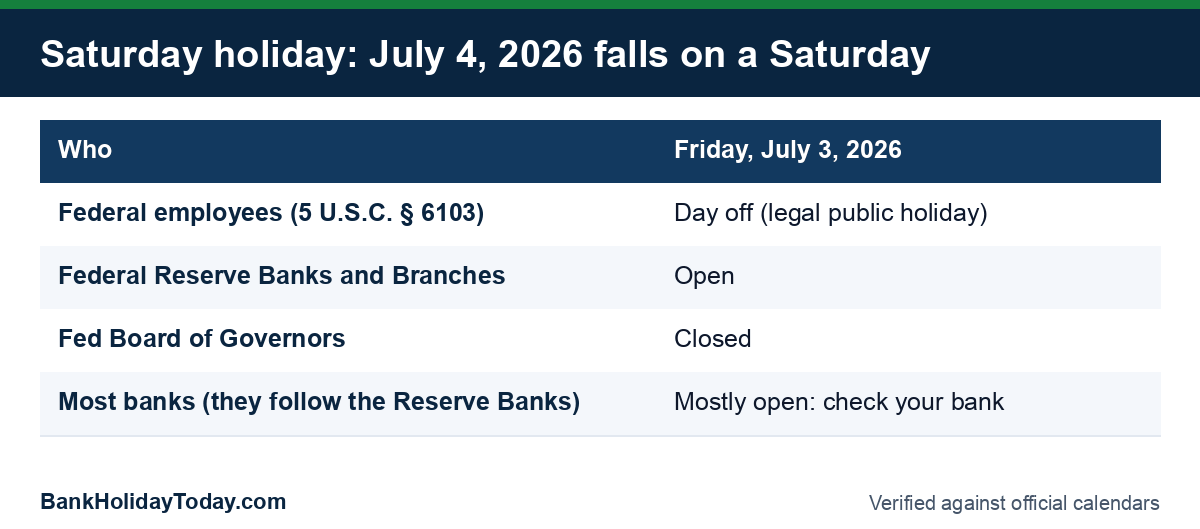
The two calendars diverge when a holiday falls on a Saturday. Under § 6103, the preceding Friday becomes the legal public holiday for federal employees whose workweek is Monday to Friday. The Federal Reserve takes the opposite approach: for a Saturday holiday its Reserve Banks and Branches stay open the preceding Friday, although the Board of Governors is closed that day.
This is not a theoretical edge case. Independence Day, July 4, 2026, is a Saturday. Federal employees get Friday, July 3 off, but the Reserve Banks are open that day, and most banks follow the Fed.
Sunday holidays work differently
When a holiday falls on a Sunday, the observed day is the following Monday for both groups. The Fed’s schedule says all Federal Reserve offices close the following Monday. For federal employees the rule comes from an executive order rather than from § 6103 itself, but the effect is the same.
Other days that close some banks but are not federal holidays
Some states add their own holidays. Texas, for example, observes the day after Thanksgiving and Christmas Eve for state offices, but banks follow the Fed and stay open. Election Day is not a federal holiday in § 6103, although some states and employers treat it as one. Good Friday is not a federal holiday either, and US banks are open, which surprises people who know it as a bank holiday in the UK and India.
The stock markets run on their own calendar. The NYSE and Nasdaq stay open on Columbus Day and Veterans Day while banks are closed, and they close on Good Friday while banks are open.
Why the difference matters for your money
The practical effect shows up in payment timing. Payroll providers, landlords and billers often use the federal calendar to decide when to send money, while the banks settle on the Fed calendar. When the two disagree, a payment can arrive a day earlier than you expect, or a government office can be closed while your bank is open and able to process a deposit. Knowing which calendar applies to the thing you are doing, a bank transaction or a federal office visit, saves a wasted trip.
Quick reference: which calendar applies to what
Visiting a federal office, a post office or a federal court: use the federal holiday calendar, and remember the Friday-before rule for Saturday holidays. Going to a bank or moving money between banks: use the Federal Reserve K.8 schedule. Trading shares: use the exchange’s own calendar, which differs from both. Working for a private company: use your employment contract, because nothing in federal law obliges a private employer to close on a federal holiday.
How to plan around the difference
If a holiday falls on a Saturday, do not assume Friday is a bank holiday, and do not assume your payment will be delayed: check the Fed schedule or your bank. If it falls on a Sunday, expect Monday to be closed. The full list of 2026 dates is in our guide to how US bank holidays are decided.
Quick answers
Is every federal holiday a bank holiday?
Almost. The Federal Reserve closes on the same 11 holidays, and nearly all banks follow. The exception is a Saturday holiday: federal employees get Friday off, but the Reserve Banks stay open that Friday.
Are banks open on July 3, 2026?
Mostly yes. July 4, 2026 is a Saturday, so federal employees are off on Friday, July 3, but the Federal Reserve Banks are open, and most banks follow the Fed. Check your own bank.
Is Election Day a federal holiday?
No. Election Day is not one of the 11 holidays listed in 5 U.S.C. § 6103, and banks are open, although some states and employers give the day off.
Is Good Friday a federal holiday?
No. Good Friday is not a US federal holiday and US banks are open, even though it is a bank holiday in the UK and India.
Who decides when banks close in the US?
Each bank decides its own hours, but they follow the Federal Reserve’s K.8 holiday schedule because the Fed runs the main payment settlement systems.
Is Inauguration Day a bank holiday?
No. Inauguration Day is a holiday only for certain federal employees in the Washington, DC area, once every four years, and it is not on the Federal Reserve holiday schedule.
Sources
- 5 U.S.C. § 6103 — Holidays (Cornell LII)
- Federal Reserve — holiday schedule (K.8)
- Nacha — definition of banking day and related topics
Dates and rules were checked against the sources above. Holiday calendars can change; confirm with your bank before a time-sensitive transaction.