
What Is a Bank Holiday? Meaning, Rules & Examples
A bank holiday is a day on which banks and most financial institutions are officially closed to the public. Branches shut, cheques and traditional transfers wait for the next working day, and the date is set by law, by a central bank schedule or by a government notification, depending on the country.
The phrase means slightly different things in the United States, the United Kingdom and India, which is why people often get confused. This guide explains where the term came from, how each country decides its bank holidays, and what keeps working while the branches are closed. For today’s live answer, use our bank holiday checker.
Where the term “bank holiday” comes from
The term is British. Before 1871, most workers had few days off, and banks were a special problem: anyone holding a bill of exchange could demand payment on any day that was not a recognised holiday, so banks could not simply close. The Bank Holidays Act 1871, introduced in the House of Commons by the banker and scientist Sir John Lubbock, solved this. Business that fell due on a bank holiday was pushed to the next day without penalty, which let banks, and soon most other employers, close for the day. The new days were nicknamed “St Lubbock’s Days”.
The 1871 Act was repealed a century later by the Banking and Financial Dealings Act 1971, which is still the legal basis for UK bank holidays today. Extra days can be added by Royal Proclamation, which is how one-off holidays such as royal jubilees are created.
Bank holiday vs public holiday vs federal holiday
In everyday speech the three terms overlap, but they are not the same thing. A public holiday is a day off for most people. A bank holiday is a day banks are closed. A federal holiday, the term used in the United States, is a day the federal government and its employees are off. The same date can be all three, only one or two of them.
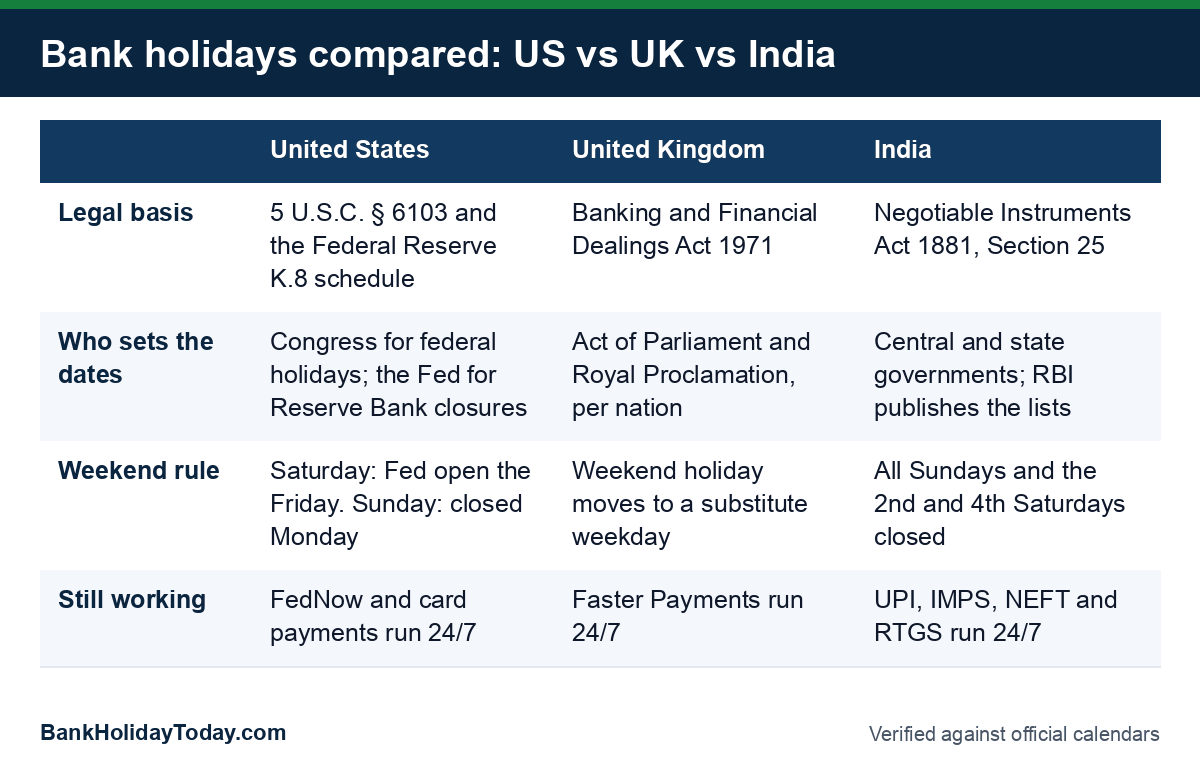
The table below compares how the three countries covered by this site define and set their bank holidays.
How bank holidays work in the United States
In the US, “bank holiday” is an informal term. The law that names holidays is 5 U.S.C. § 6103, which lists 11 federal holidays for federal pay and leave. Banks are private businesses and are not legally required to close on any of them. In practice they follow the Federal Reserve, whose K.8 schedule lists the same 11 holidays for the Reserve Banks. When the Fed is closed, the main settlement systems pause, so nearly every bank, credit union and brokerage closes with it.
The phrase has one famous historical use: in March 1933, President Franklin D. Roosevelt declared a nationwide emergency “bank holiday” that closed every bank for several days during the banking crisis. That was a closure to stop panic withdrawals, not a calendar holiday.
How bank holidays work in the United Kingdom
The UK has the most formal system. Bank holidays differ by nation: England and Wales, Scotland and Northern Ireland each have their own list on GOV.UK. When a bank holiday falls on a weekend, a substitute weekday, usually the following Monday, becomes the bank holiday. In 2026, for example, Boxing Day falls on a Saturday, so the bank holiday moves to Monday, December 28.
A bank holiday does not give every worker the right to a day off. GOV.UK states that employers do not have to give employees paid leave on bank or public holidays; it depends on the employment contract.
How bank holidays work in India
In India, bank holidays rest on Section 25 of the Negotiable Instruments Act, 1881, which lets the central and state governments declare days as public holidays for the purposes of the Act. That is why India has both national bank holidays and state-specific ones: a festival can close banks in Maharashtra while Gujarat stays open. The Reserve Bank of India publishes the holiday lists by state and regional office.
India also has a weekly rule that has no equivalent in the US or UK: banks are closed on every Sunday and on the 2nd and 4th Saturdays of the month. We explain it in our guide to how the RBI decides India’s bank holidays.
Four common myths about bank holidays
Myth one: a bank holiday means everyone has the day off. In the UK, GOV.UK says employers do not have to give paid leave on bank holidays, and in the US many private employers work through federal holidays. Myth two: banks are closed on every Saturday. In the US and UK many branches open on Saturday mornings, and in India only the 2nd and 4th Saturdays close.
Myth three: the same date is a bank holiday everywhere. Good Friday closes banks in the UK and India but not in the US, and Columbus Day closes US banks but not UK or Indian ones. Myth four: you cannot move money on a bank holiday. You can, as long as you use a system that runs around the clock, which is covered in the next section.
What still works on a bank holiday
Only branches and some slower payment systems close. ATMs, card payments and mobile banking apps work as normal. Instant payment systems, including FedNow in the US, Faster Payments in the UK and UPI, IMPS, NEFT and RTGS in India, run around the clock. Older systems such as US ACH and Fedwire, and UK CHAPS, pause and catch up on the next business day. Our guide on what works on bank holidays covers the detail.
Quick answers
What does bank holiday mean?
A bank holiday is a day when banks are officially closed to the public. The dates are set by law or government notification, and branches reopen on the next working day.
Why is it called a bank holiday?
The term comes from the UK’s Bank Holidays Act 1871, which let banks close without penalty on named days by pushing payments due on those days to the next working day.
Is a bank holiday the same as a public holiday?
Not always. A bank holiday closes banks; a public holiday is a day off for most people. Many dates are both, but some days, such as Columbus Day in the US, close banks while many businesses stay open.
Do all banks close on a bank holiday?
Almost all do. In the US banks are not legally required to close, but nearly all follow the Federal Reserve. Always check your own branch, because a few open on some federal holidays.
Are ATMs and online banking available on a bank holiday?
Yes. ATMs, card payments and mobile and online banking keep working. Only branch counters and some older payment systems close.
Is Sunday a bank holiday?
Sundays are not listed as bank holidays, but banks are closed on every Sunday in the United States, the United Kingdom and India.
Sources
- 5 U.S.C. § 6103 — Holidays (Cornell LII)
- Federal Reserve — holiday schedule (K.8)
- GOV.UK — UK bank holidays
- Banking and Financial Dealings Act 1971 (legislation.gov.uk)
- Reserve Bank of India — holiday matrix
Dates and rules were checked against the sources above. Holiday calendars can change; confirm with your bank before a time-sensitive transaction.